

Is your car whispering—or clicking—about a drivetrain issue? In the automotive aftermarket, the CV Axle (Half Shaft) is a high-volume component but also one of the most frequently misdiagnosed. Whether you’re steering a hardworking Chevrolet Silverado, a reliable Toyota Corolla, or a versatile Subaru Forester, a "one-and-done" repair starts with precision.
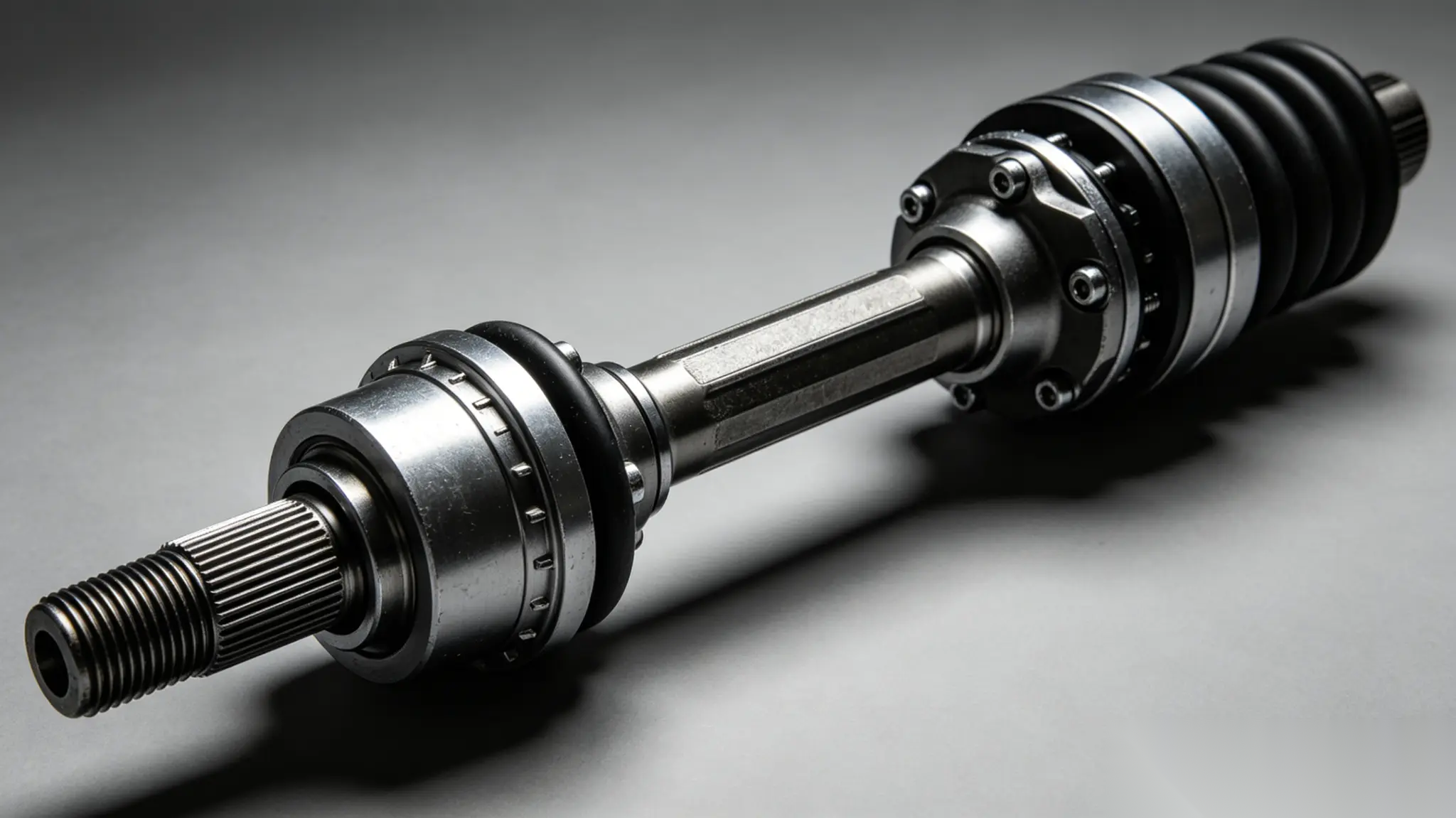
Red Flags: How to Tell Your CV Axle is Failing
Before diving into the tools, listen to what your vehicle is telling you. A failing half-shaft usually presents itself through three distinct sensory warnings:
- The "Clicking" Metronome: A loud, rhythmic metallic clicking noise when making sharp, low-speed turns (like pulling into a parking spot). This typically signals a compromised Outer Joint.
- The Highway Shudder: A side-to-side wobble or vibration during heavy acceleration that oddly disappears once you lift your foot off the gas. This is a classic sign of Inner Joint wear.
- The "Grease Tornado": If you see thick, dark grey/black, "toothpaste-like" grease splattered in a radial (spinning) pattern inside your wheel rim or across the engine block, the protective boot has torn.
To avoid triggering an ABS light or swapping a perfectly good axle when a $10 seal is the culprit, follow this professional 6-step diagnostic protocol.
Step 0: Driveway vs Shop Audit
Before getting under the chassis of your GMC Sierra or Jeep Grand Cherokee, determine the scope of work.
- Green Light (DIY-Friendly): Point-to-point replacement of a Complete CV Axle Assembly.
- The Arsenal: You’ll need a 32mm or 36mm axle nut socket (size varies by model), a heavy-duty pry bar, a 2-ton jack, and a calibrated torque wrench.
- Red Alert (Pro Required): If the axle has snapped inside the differential housing or the repair requires removing subframe or engine mounts, it’s time for a professional lift.
Step 1: Systemic Exclusion
- Wheel Bearings: A constant humming that changes pitch when swerving. The 12 & 6 Test: Jack up the car; if there’s "play" at the 12 and 6 o'clock positions, it’s the bearing.
- Tire Balance: Vibration at speeds above 80 km/h (50 mph) that persists whether you are accelerating or coasting.
- Suspension Bushings: Metallic "clunks" over speed bumps on a Nissan Rogue or Honda CR-V usually point to control arm bushings, not the axle.
Step 2: ABS Tone Ring Factor
The ABS Tone Ring is a critical subset of the axle assembly.
- The Critical Matching: You must verify the Tooth Count (e.g., 52-teeth vs. 44-teeth) on the outer axle stub.
- Pro Tip: Installing a mismatched count on a Ford Explorer or Hyundai Elantra will immediately disable your ABS and Traction Control systems.
Step 3: Load-Dependent Testing
CV Axle failures react specifically to Engine Load and Steering Angle:
- The "Clicking" (Outer Joint): Rhythmic metallic clicking during sharp turns. This is the "smoking gun" for Front-Wheel Drive (FWD) cars.
- The "Shudder" (Inner Joint): Side-to-side cabin shaking during heavy acceleration that vanishes the moment you lift your foot off the gas. In Rear-Wheel Drive (RWD) vehicles, this vibration is often felt in the seats or floorboard.
Step 4: Visual Forensic Test
- Pattern A: CV Boot Failure (Axle Issue)
- Texture: High-viscosity, dark grey/black, "toothpaste-like" Grease.
- Evidence: Grease splattered in a radial (spinning) pattern on the wheel well.
- Verdict: Replace the Complete CV Axle Assembly.
- Pattern B: Transmission Seal Failure (Seal Issue)
- Texture: Thin, translucent (Red, Amber, or Yellow) Liquid Oil.
- Evidence: Fluid dripping straight down where the axle enters the transmission.
- Verdict: Replace the Transmission/Axle Seal, not the axle.
Step 5: Diagnostic Matching Table
Match your diagnosis to the correct hardware:
| Diagnostic Finding | Recommended SKU | Why? |
|---|---|---|
| Clicking on turns + Radial grease | Complete CV Axle Assembly | Fixes Outer Joint wear and seals the system. |
| Acceleration shudder + Firm axle | Complete CV Axle Assembly | Resolves internal Inner Joint pitting/wear. |
| ABS Light + Damaged Tone Ring | Complete CV Axle Assembly | Restores 1:1 signal sync to the ECU. |
| Liquid oil dripping (Axle is firm) | Transmission / Axle Seal | Fixes the leak without replacing a healthy shaft. |
Summary: One-and-Done Rule
By identifying the difference between Grease (Axle) and Oil (Seal) and confirming your ABS Tooth Count, you move from "part-swapping" to "precision engineering". To ensure your new hardware integrates perfectly with your vehicle's specific drivetrain, always use an Advanced YMM (Year-Make-Model) Search Tool. Entering your precise vehicle details is the only way to guarantee a "First-Time Fix" and avoid the headache of return shipping.